
Skilled Migration to Australia
Skilled visas are for people who qualify on their occupation, points and English rather than through a sponsor. The right choice depends on your points, your occupation and where you are willing to live. We assess your options honestly before you spend money on assessments or invitations.
Skilled migration uses a points test to invite people who have skills Australia needs. The 189 is permanent and needs no sponsor, the 190 is permanent with state or territory nomination, and the 491 is a regional visa that leads to permanent residence. Which of the three suits you depends on your occupation, your points and where you are willing to live.
Choose your visa
- Skilled Independent Visa (189)A points-tested permanent visa with no sponsor and no state nomination.Learn more
- Skilled Nominated Visa (190)A permanent visa for skilled workers nominated by a state or territory.Learn more
- Skilled Work Regional Visa (491)A provisional visa for living and working in regional Australia, with a route to permanent residence.Learn more
- Permanent Residence (191)The permanent visa for 491 and 494 holders who have lived and worked in a regional area.Learn more
Compare the visas
| Visa | How it works | Key facts |
|---|---|---|
| Skilled Independent (189) | Points-tested, no sponsor | Minimum 65 points; under 45; lodge an Expression of Interest (EOI) in SkillSelect and wait for an invitation; offshore or onshore |
| Skilled Nominated (190) | Nominated by a state or territory | Permanent residence from grant; state criteria apply |
| Skilled Work Regional (491) | Provisional visa for regional Australia | Up to 5 years; can move to permanent residence through the 191 visa after 3 years |
Skilled Independent (189)
- Points-tested permanent visa with no sponsor and no state or territory nomination
- You lodge an Expression of Interest (EOI) in SkillSelect and wait for an invitation
- Competitive, so your points, occupation and English matter
Skilled Nominated (190)
- Permanent visa for people nominated by a state or territory
- Each state or territory sets its own criteria and occupation lists
- We check the state’s requirements before you commit
Skilled Work Regional (491)
- Provisional visa for living and working in regional Australia
- Can lead to permanent residence through the 191 visa after 3 years
- A good fit if you are willing to live outside the major cities
Check before you apply
For the 190 and 491, every state sets its own rules
A state or territory nomination is needed for the 190 and the 491. Each state decides who it nominates and when.
- Occupation listsEach state or territory nominates only from its own list of occupations, and the lists change.
- Residence and workSome require you to already live or work in the state. Others invite applicants from overseas.
- Extra criteriaEnglish level, work experience, qualifications and job offers can be set above the national minimum.
- Timing and placesNomination places and opening dates vary through the year, so the rules can change before you apply.
- Living in the stateStates generally expect you to settle and work in the state that nominates you.
We check the current requirements of each state or territory that fits your occupation before you apply.
Skills assessment
Skills assessment, with our help
A positive skills assessment for your nominated occupation is needed before you can lodge an Expression of Interest (EOI).
Many applicants ask us to help with their skills assessment, because the assessing authority’s rules are strict and a weak application can cost months.
Ask about a skills assessmentAssessing authority fees are set by the authority and are separate from ours.
- The right authorityWe identify the assessing authority and the assessment that applies to your occupation.
- Eligibility firstWe review your qualifications and experience against the requirements before you pay any fees.
- Guidance on your evidenceWe explain what the authority expects, such as employment references and duties, and review what you have gathered before you submit.
- Support to the outcomeWe help you understand and respond to the authority’s requests until the outcome is issued.
How we help
- Check your points and occupation before you commit
- Plan skills assessment and English test timing
- Prepare the Expression of Interest (EOI) and state nomination applications, including Registration of Interest (ROI) applications where required
- Lodge the visa application once invited
Common pitfalls
- Claiming points you cannot document
- Letting an invitation or nomination lapse
- Choosing a pathway without checking state criteria
Related articles
 Skilled MigrationVictoria Publishes Its Own Points Test: What 190 and 491 Applicants Need to Know (2026–27)Victoria has published the Victorian Points Test (VPT), which ranks every Registration of Interest (ROI) for the 190 and 491 visas in the 2026–27 program year.Read the article
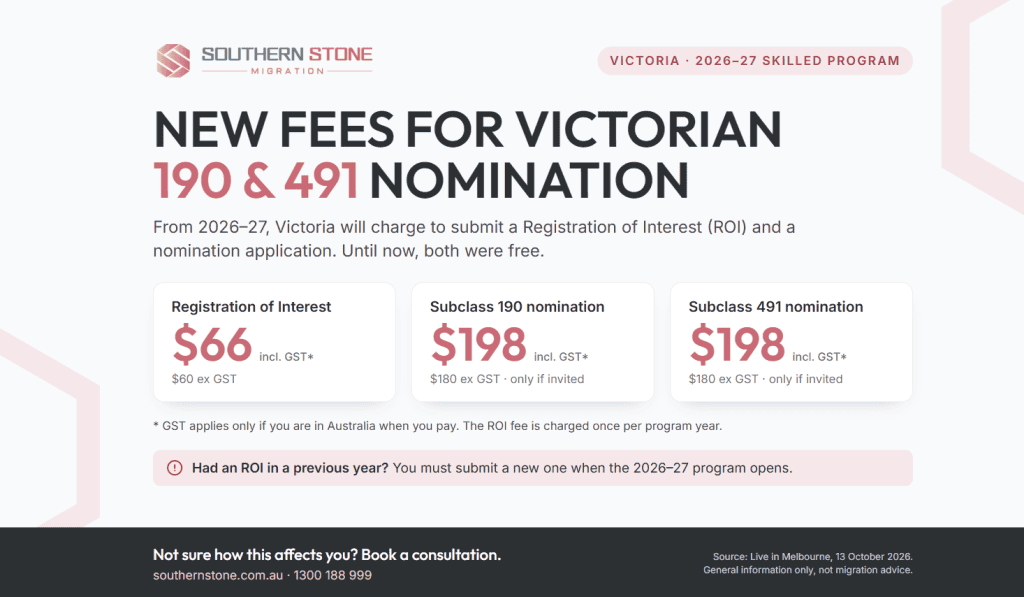 Skilled MigrationVictoria Introduces Fees for 190 and 491 ROIs and NominationsVictoria will charge fees for Registrations of Interest (ROIs) and nomination applications for the Skilled Nominated (subclass 190) and Skilled Work Regional (subclass 491) visas from the 2026–27 program year.Read the article
Frequently asked questions
What is the minimum points score?
The minimum is 65 for the 189, though invitations are competitive and usually need more. We review your points honestly and let you know where you stand before you spend money on assessments or tests.
Which visa is fastest?
It depends on your occupation, points and state demand, and these change over time. We assess your situation and explain which pathway looks most realistic, without promising an outcome or a timeframe.
Can I apply from Australia?
Yes. The 189 can be lodged onshore or offshore. Where you live now does not decide your eligibility, but it may affect timing and practical steps, which we can talk through with you.
What is the difference between the 189, 190 and 491?
The 189 is points-tested with no sponsor. The 190 is nominated by a state or territory and gives permanent residence from grant. The 491 is a provisional visa for regional Australia, with a route to permanent residence through the 191 after 3 years.
What is an Expression of Interest (EOI), and what happens after it?
For the 189 you lodge an Expression of Interest (EOI) in SkillSelect and wait for an invitation. For state nomination, the state’s criteria also apply. Once invited, you lodge the visa application, and we help you meet each deadline.
What are the common mistakes to avoid?
The most common are claiming points you cannot document, letting an invitation or nomination lapse, and choosing a pathway without checking state criteria. Checking your evidence early helps avoid all three.